Builder Showcase: Mychal Pejana, Lead Developer of Paiflow
BUILDER SHOWCASE 5 min read Artisam Labs
The second entry in our Builder Showcase series is Mychal Pejana, Lead Developer of Paiflow. If you read our first showcase with Carl Macabales, you already know half of the Paiflow origin story. This is the other half — and it starts with an email.
Who he is
Mychal is a Computer Science graduate of FEU Institute of Technology. He joined Artisam Labs as an intern and today leads the build of Paiflow, the drag-and-drop programmable-payments tool for Stellar that came out of the Build on Stellar Philippines Hackathon in May 2026.
Ask him what he does for fun and the answer is a little unusual for someone who spends his days on a blockchain product: he reads about the history of computing. He is genuinely taken with how the field’s forefathers managed, in his words, to “trick a rock into thinking.” On weekends, he plays badminton.
A typical day
His mornings have a fixed shape. Before breakfast, the laptop is already open — not to work, but to spend a short stretch studying a domain he is curious about. Then he eats, cleans his workspace, plans the day, and only then dives head-first into the tasks.
It is a small routine, but it explains a lot of what follows. Mychal treats learning as a scheduled activity, not something that happens when there is time left over.
How he got here
Mychal applied for his internship the plainest way possible: through email. He describes the timing as “peculiar” — he arrived knowing nothing about either AI-assisted development or blockchain, and those two things now make up nearly all of the work he does.
The turning point was the Build on Stellar Philippines Hackathon, a seven-day online build that ran May 18–24, 2026. Mychal and Carl Macabales entered under the mentorship of Artisam Labs co-founder Mark Hugh Neri with a product then called Pink Raft. Out of more than 30 teams, it took 1st runner-up at the final pitch at PDAX and went on to represent the Philippines at the APAC Stellar Hackathon Grand Finale. Pink Raft became Paiflow, and the intern became its lead.
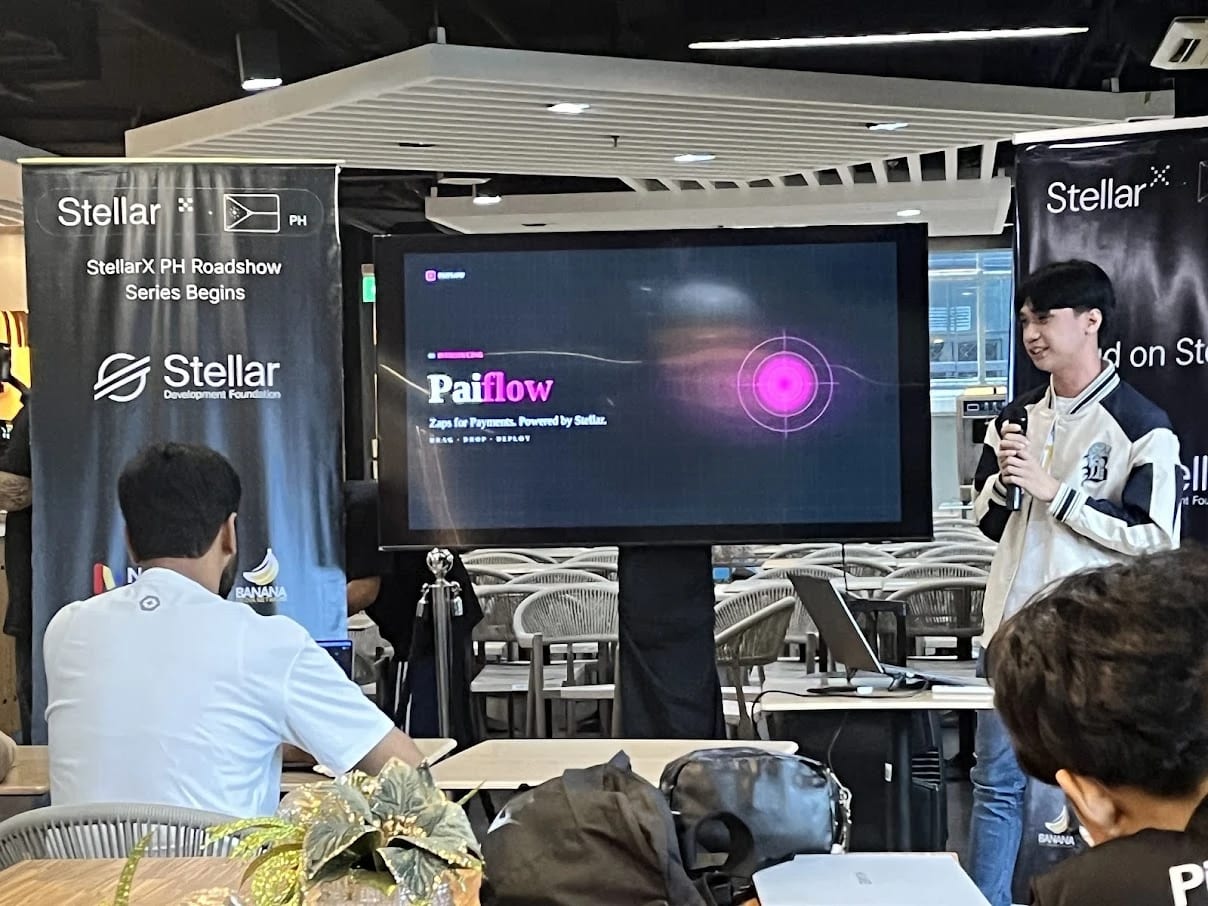
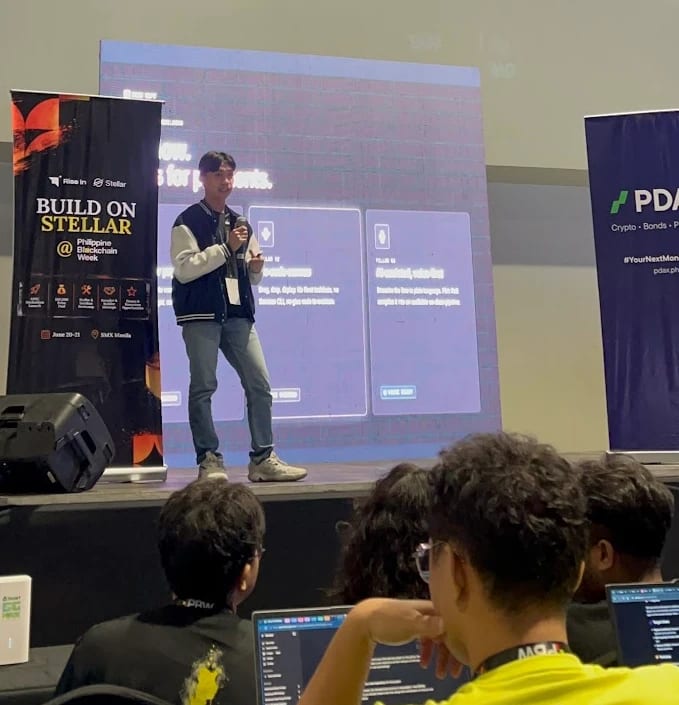
Since then, Mychal has become the face of the product on stage: he pitched Paiflow at Philippine Blockchain Week 2026 in June — the cover photo of this post is from the Build on Stellar stage at SMX Manila — then at the StellarX Demo Day in July and at the StellarX PH Roadshow.
What he does now
Paiflow is currently in the middle of a Stellar Instaward: a $5,000 grant from the Stellar Development Foundation, structured as a funded sprint to push an app’s development forward on the network. Mychal is running that sprint.
The product itself is an accessibility layer for Soroban. Instead of hiring a Rust developer to write a custom contract, a user composes a payment flow on a visual canvas — triggers like On Receive and On Schedule, actions like Pay, Split, and Condition — and deploys one of three pre-audited contract templates straight from their own wallet. The backend only builds and simulates the transaction; the wallet signs it, and funds never touch Paiflow’s servers.
The planning loop
Like Carl, Mychal has AI assisting him through almost the entire development cycle. What makes his version worth describing is how deliberately he sequences it.
Plan by hand first. He does the initial planning manually, without the model. Only then does he bounce the plan off the AI, and he repeats that refinement loop until the plan is one he is satisfied with.
Turn the plan into issues. Before any implementation, he writes the work up as issues. The reason is specific: the AI needs a single source of truth to validate against while it implements. An issue is a contract the model can be checked against; a chat transcript is not.
Test and review in a fresh session. Once the implementation is done, he has the AI test and review its own output — but in a new session, so the reviewer is not carrying the assumptions of the author.
Close the loop manually. When the AI is finished, he verifies the output himself and goes back to the original plan to check whether the issue was actually solved, not just whether the code runs.
His favourite model for this is Claude Fable 5.1 — “however it is a bit pricey.”
Advice for people learning blockchain and AI
Mychal’s advice is the oldest line in the programming world, and he means it literally: read the documentation first.
His reasoning is about scale. AI and blockchain are each very large domains, and nobody gets them on day one. Rather than skimming across both, he recommends picking a field and making the foundation solid by learning its cornerstones — the ideas everything else in that field is built on. It is the same philosophy as his pre-breakfast study sessions: fundamentals, deliberately, before the day’s work.
What’s next for Paiflow
Mychal is candid about where the product stands. Paiflow traces its roots to hackathons, and it still shows: there is “much to be desired in terms of security, bugs, and feature completeness.” The current sprint is about hardening it.
After that, the roadmap has two milestones. The first is off-ramping via MoneyGram, so value that moves through a Paiflow contract can leave the network as cash. The second is the one the team has been building toward since May: an official launch on Stellar mainnet.
What’s next for Mychal
His answer is one word: mastery. He is currently studying computer networks from the ground up, driven by the same curiosity that pulls him toward computing history — he finds it remarkable that the whole world can be connected through the internet at all. In parallel, he is deepening his understanding of blockchain, with a particular focus on the Stellar chain.
Once that foundation is in place, he plans to build a new app using everything he has learned. What it is, he isn’t saying yet. “The details are still a secret for now ;).”
Builder Showcase puts the people behind Artisam Labs projects in front of other builders. Read the first entry, Carl Macabales on Centient, and follow Paiflow as it heads toward mainnet.
Gallery