Builder Showcase: Carl Macabales, Lead Developer of Centient
BUILDER SHOWCASE 6 min read Artisam Labs
Our Builder Showcase series puts the people behind Artisam Labs projects in front of other builders. First up: Carl Macabales, Lead Developer of Centient — and, as it happens, the right person to introduce our next webinar, 9 Ways to Run an Agent on September 17. More on that at the end.
Who he is
Carl recently finished a bachelor’s degree in Computer Science at Mapúa University, specializing in Artificial Intelligence. Before Artisam Labs he was a Software Engineering Intern at The BLOKC; he now works with us part-time.
Off the keyboard: competitive MOBAs and RPGs, cars (“if it has wheels and an engine, count me in”), and just about any sport with a scoreboard — basketball, American football, football, tennis. His GOAT is LeBron James. “Not debatable. Haha.”
He has also drifted into computer building and IoT. A Raspberry Pi currently runs as his personal storage server, with more IoT projects planned around it.
A typical day
Honestly, it’s usually a pretty normal day. I wake up, get some work done, spend a good chunk of the day coding, exercise, and then sometimes work on personal projects or improve my portfolio.
The side projects matter to him for a specific reason: they are where he gets to use technologies that don’t come up at work. “A lot of what I learn comes from just finding something interesting, building it, breaking it, and figuring out how to make it work.”
How he got here
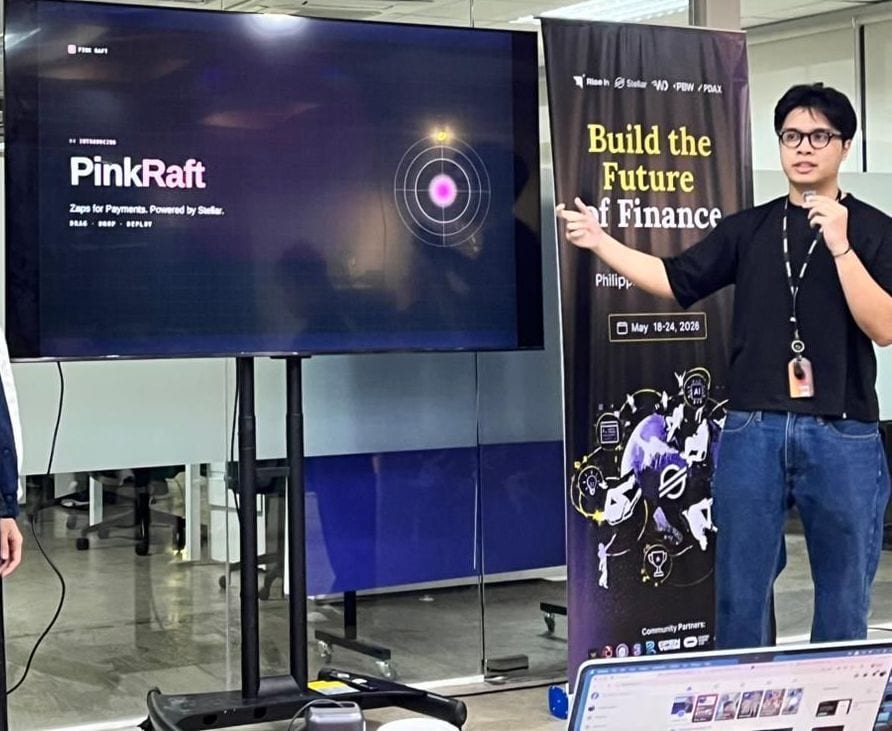
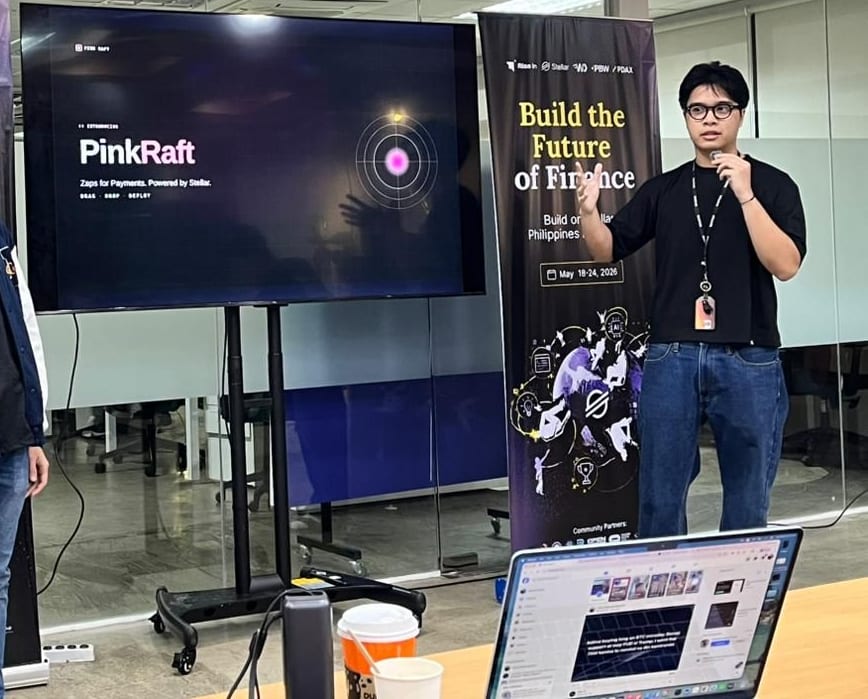
Carl’s first contact with Artisam Labs was a Stellar hackathon — his first hackathon of any kind. He went in not knowing what to expect and came out with a podium finish: Pink Raft, later Paiflow, took 1st runner-up at the Build on Stellar Philippines Hackathon in May 2026, then went on to the APAC finale. The photos in this post are from that hackathon’s final pitch.
That hackathon was also one of my first real exposures to building something around blockchain technology, so it ended up becoming a pretty important starting point for me.
What he does now
Carl is Lead Developer for Centient, which recently received a $5,000 Instaward grant from the Stellar Development Foundation. Most of his time goes to system architecture and to how the application integrates with Stellar’s payment rails. He also works closely with QA to make sure what ships behaves as intended across the whole system.
The part that’s most relevant to next week’s webinar is how he works:
My development workflow is heavily AI-driven and automated. I try to reduce as much repetitive development work as possible so I can spend more of my time thinking about system design, product decisions, architecture, and the harder engineering problems.
Inside the AI-driven workflow
We asked him to be concrete. Four things stood out.
Scheduled tasks and routines. He uses automation features — particularly in Claude — to take repetitive work off the table. The hard part of engineering, in his view, is still identifying the actual problem and designing the right architecture. Once those are defined, AI helps break the work into issues, organize the implementation, and work through it systematically.
MCPs. He’s a strong advocate for the Model Context Protocol. Working solo across several services means constantly switching between the editor, GitHub, databases, hosting, dashboards, and docs — and it gets worse as the codebase grows. MCPs let the AI tooling talk to those services directly, so more of that context lives in one workflow with far less tab-hopping.
Documentation. Where he used to search hundreds of pages by hand, he now asks a specific question and gets to the relevant part. “I still validate important details, but the amount of time saved is massive.”
Favourite model. Claude, mostly, for software development and long coding sessions. “I like being able to treat AI less like a chatbot and more like another tool inside my engineering environment.”
Advice for people learning blockchain and AI
On AI, his warning is against standing still. You don’t have to chase every model or framework, but you should keep understanding how these tools are changing the way software gets built, and learn to use them well.
On blockchain, he was once as overwhelmed as any beginner — and was surprised by how much carried over:
I originally thought blockchain development would be completely different from traditional software engineering. What surprised me was how many familiar concepts still apply: APIs, backend services, databases, system architecture, authentication, event-driven systems, and good software engineering practices. You’re still solving many of the same problems — blockchain simply introduces a different infrastructure, trust model, and way of handling ownership and transactions.
Both fields look intimidating from the outside because of the vocabulary. His fix is the same for either: start with one problem, build something small, and learn the technologies as you need them.
What’s next for Centient
The immediate priority is completing the scope of work for the current 30-day Instaward. After that, the team plans to apply for a second Instaward and keep building, with an SCF Build Award as the larger goal.
Beyond grants, the point is to make Centient sustainable and useful past the hackathon-and-showcase stage — better product, stronger AI evaluation capabilities, deeper Stellar integration. “What we have now feels much more like the beginning than the finished product.”
What’s next for Carl
Career-wise, he’s aiming at AI, machine learning, and data roles, and is deliberately building side projects that force him to integrate LLMs into real business solutions rather than “another AI demo or wrapper” — the full engineering loop of understanding the problem, designing the system, integrating and optimizing the models, and deploying something people actually use.
One current project is a computer-vision system that detects and evaluates a person’s posture, running on a Raspberry Pi. Getting the model to perform on that little hardware took a lot of optimization and experimentation; it’s now being written up as a research paper to add to his existing publications. A master’s degree is on the list too, once he’s established professionally.
His closing line for other builders:
I don’t think you have to be born exceptionally talented to become good at something. Being consistently curious and almost obsessively passionate about what you do can take you surprisingly far. You don’t have to know everything when you start — you just have to care enough to keep figuring things out.
Webinar: 9 Ways to Run an Agent — September 17
If Carl’s workflow sounds like the one you want, this session is the practical follow-through. 9 Ways to Run an Agent is for builders who are done “prompting and praying” and want reliable work out of their AI coding agents. Rather than naming tools, it digs into the workflows behind them — Codex sandboxes for safe, isolated execution, AGENTS.md to give an agent lasting context and rules, and cloud tasks to offload long-running work so you’re not babysitting it — and how to pick the right approach for your project.
- When: Thursday, September 17, 2026, 9:00 PM (GMT+8)
- Where: Online, via Google Meet
- Host: BlockHub Academy, powered by Artisam Labs
Gallery